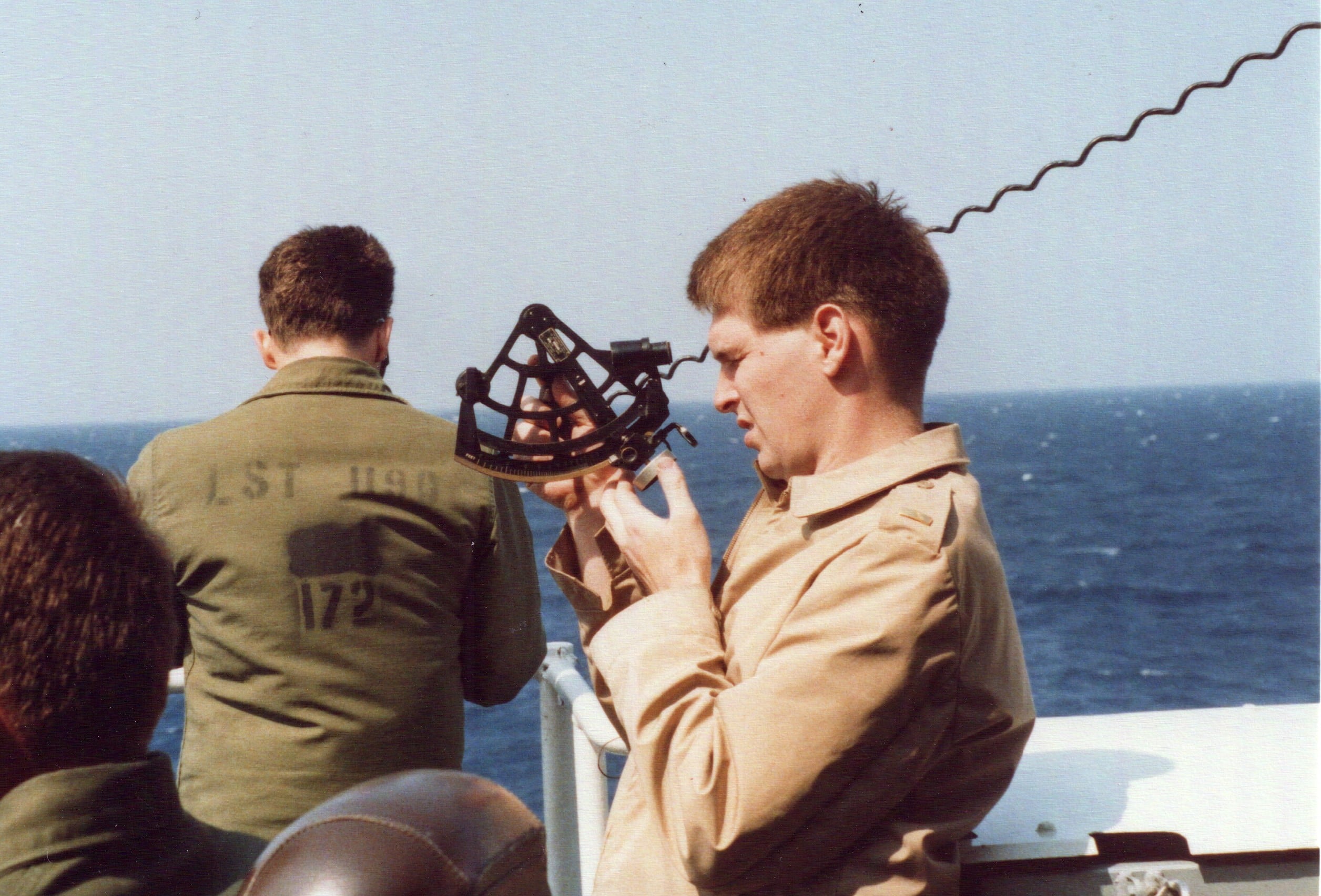
A note before we start: the officers in this story are real. Their names are not. I’ve changed them to protect their privacy, not to soften what happened.
This is the first of three parts about a Navy ship, three commanding officers, and a lesson I spent the next thirty years watching repeat in every organization I worked with: conditions matter, but they matter far less than the leader standing in them. A strong leader with weak systems will consistently outperform a weak leader with perfect systems. [1] That’s the lesson underneath everything that follows.
November 1987, a few weeks before I was due to finish my first Navy professional school: the four-month Division Officer Course at Surface Warfare Officer School in Newport, Rhode Island, also known as Baby SWOS. I was looking forward to getting back to my ship, USS Raleigh. I’d already spent time aboard her after graduating and being commissioned in May, before coming to Newport, and I was ready to return. Then I went to get my mail and found a letter from an officer I didn’t know, on a ship I’d never heard of, USS Boulder (LST-1190). I opened it and was shocked to read that it was a welcome-aboard letter from the man I was supposed to be replacing as communications officer. The real shock was the ship itself. Boulder, I discovered, was part of the Naval Reserve Fleet. So that meant half a crew, and no full deployments. I was a newly commissioned active-duty officer, not a reservist, but I was being sent to serve on a reserve ship. Confusion is an understatement.
I went to personnel immediately. They had to call Washington. I was quickly handed orders to stay in Newport for the six-week Communications Officer course. I also called Raleigh. My captain there was just as confused. They hadn’t received my change of orders either. The Navy had sent my new orders to Cornell, where I’d been commissioned, and to Boulder, the ship I was headed to, but not to Raleigh, the command I was actually assigned to, or to Newport, where I actually was.
Talk about bureaucracy. But it got better. I was on short-term orders to Newport, which meant I was on per diem. The Communications Officer course pushed me past what counted as short-term, and the Navy came asking for their per diem back. Thankfully, once they figured out the screw-up was theirs and not mine, I didn’t have to repay it. I just had to live on my normal salary instead.
I finally reported aboard Boulder in January 1988. I found out later that she had been sitting in New York Harbor for a while, and the time hadn’t been kind to her or the crew.
After I reported aboard, I was told by several senior people, enlisted and officer, that roughly half the crew and a few officers had been replaced in the last few months. Part of the explanation making the rounds traced back to two real Navy programs from that decade: a base-expansion push tied to the Reagan-era buildup toward a six-hundred-ship Navy, and a hometown recruiting program that had recruiters emphasizing sailors could end up stationed close to home. Whatever the actual mechanism, the practical result on Boulder was a crew that included sailors from rival gangs, the Bloods and the Crips, serving side by side.
My first real insight into what was in store for me came the night before my official report date. I drove to Little Creek to make sure I knew where the ship was, and I went to the quarterdeck to introduce myself. The officer of the deck was a first class quartermaster who would later work for me when I became navigation officer. He asked me why I was there. I told him I was reporting for duty in the morning and wanted to make sure I knew where the ship was. His first words weren’t what I expected.
“Sir, do you have any leave left?”
I said, “What?” I was shocked that he would ask me this.
“If you have any leave left, sir, take it. You don’t want to be here.”
I was in shock. I looked around and suddenly realized what I was actually seeing. Rust everywhere. That was my introduction to the Boulder, my home for the next two years.
The first captain
By the time I reported aboard, Commander Reyes was in the last few months of his two-year tour, retiring upon completion. Old school, the kind of officer who’d earned respect the traditional way, through rank, bearing, and decades of doing things by the book. He was solid. He cared.
In the months after I reported aboard, we were constantly being sent out for three or four weeks at a time, in for a couple of days, and back out again, doing amphibious operations. Sometimes with Marines, sometimes with the Army, sometimes with reservists. At the same time, the crew was scraping rust and painting her. We passed every inspection that came our way and trained constantly. She still didn’t look great, but she was getting better. Scuttlebutt said the Commodore’s perspective was: “She looks like a T. She smells like a T. She is a T. I just can’t send her out for more than thirty days at a time without a crew augment.”
We were busy, and we were genuinely good at what we did. What we weren’t was inspired. There’s a ceiling that competence alone doesn’t get you past, and Commander Reyes, whether because of where he was in his career or simply who he was, ran the ship right up to that ceiling and no further. We were highly qualified. I didn’t feel real esprit de corps, real joie de vivre, until the next captain came aboard.
There was one exception to how well Reyes otherwise ran that ship, and it would matter more than any of us understood at the time. One officer had stayed who shouldn’t have: unprofessional, undisciplined, the kind of presence that works on a crew’s sense of mission like a slow infection. He held one of the most consequential jobs on the ship, typically the senior-most junior officer’s billet, the one where a single bad call has no room to be a bad call: he was the navigation officer. Reyes never removed him. Whether that was oversight, fatigue this close to retirement, or something else, I don’t know. What I know is that the ship carried that unresolved problem forward, unchanged, into the next change of command.
Then the change of command
We were at Roosevelt Roads, Puerto Rico, known in the fleet as Rosie Roads, when Commander Reyes retired and Commander Alder took over. We were there for UNITAS, the annual exercise with the Venezuelan and other South American navies; we’d dropped off a detachment of Marines who were about to continue on to a goodwill tour around South America on one of our sister ships. Man, I was envious.
I want to be precise about this part, because it still surprises me every time I think about it: the shift seemed gradual at first, but in fact was far faster than could be believed. The ship herself hadn’t changed at all. Same rust. But everything about how we operated had. We got underway from Rosie Roads and made a stop, on the way home, in Saint Thomas, on liberty Alder had arranged, not something originally scheduled, to my knowledge. The crew had been running hard for months, in and out of home port every thirty days for amphibious operations. Then we got emergency tasking: cut liberty short, get back to Little Creek, load a couple hundred Marines, twenty-two AAVs, and the rest of their equipment, and cross the Atlantic for Exercise Teamwork ’88 off Norway, replacing another sister ship that had failed her INSURV, the Board of Inspection and Survey, a career-ending inspection that had nothing to do with rust.
1. “Developing Leadership Capabilities.” McKinsey & Company, November 2013. https://www.mckinsey.com/capabilities/operations/our-insights/developing-leadership-capabilities