SAME SHIP, SAME CREW, THREE DIFFERENT OUTCOMES: PART III
A note before we start: the officers in this story are real. Their names are not. I’ve changed them to protect their privacy, not to soften what happened. (A note on pronouns: this was still the all-male combat fleet.)
This is the hardest part for me to write. It’s my personal account of my introduction to a leadership style I’d never experienced.
We reached the Haugesund shipyard on September 21st. The sun was shining, but the crew’s spirit, and especially mine, felt dark and sad. It was the last sun we’d see until we left the shipyard, a month later.
A new captain was inevitable. We didn’t know who or how soon.
By the next morning the weather matched the crew’s mood: overcast, rainy, cold, sad.
Exactly a week later, on September 28th, Commander Voss reported aboard. Immediately following the change of command later that morning, Alder left the ship, in the rain. Minutes after he departed, I heard over the 1MC, the ship’s speaker system: “Ensign Jessen, report to the captain’s stateroom.”
What? Me? Why? Voss couldn’t even have unpacked yet! The night we ran aground, I’d only been on watch for twenty minutes in CIC. Was I being court martialed? Nothing else made sense as to why I’d be called to the captain’s stateroom so quickly.
I fast walked to the captain’s stateroom. Knocked and announced myself. Voss called me inside. I opened the door, stepped in. He told me to shut the door. I stood at attention in front of his desk.
“Do you know why you’re here?” he asked.
“No, sir. I have no idea.”
“Well, I asked Commander Alder, given the circumstances of our change of command, which officers he would recommend as my navigation officer. Do you know what he said?”
“No, sir. I don’t.”
“He said, given the circumstances, the only officer I would trust as navigation officer is Mister Jessen.”
I was in shock.
“Congratulations. You’re my new navigation officer. It’s a double-edged sword. I’ll be watching you like a hawk. Dismissed.”
“It’s a double-edged sword. I’ll be watching you like a hawk.”
I stepped out of his stateroom in shock. My first thought, when I’d heard my name over the 1MC, was that I was about to be court martialed. Then Voss told me what Alder had said. I hadn’t realized how closely Alder had been watching me, or that two months was enough time for him to build that kind of trust in me. I was the most junior officer aboard.
And then, in the same breath, this total stranger, just told me he’d be watching me like a hawk. I’d just been given the highest praise and the deepest trust I’d ever received from a commanding officer. In the next breath, I was put on notice by a man who’d met me minutes earlier.
That was a forewarning of what was to come.
Voss had a completely different approach to commanding a ship, nothing like Alder’s. I was coming face to face with command and control leadership for the first time in my life.
Over time, I also discovered how much fear was driving it. On one level, I suppose that was understandable. Voss took command because of a horrible accident, caused by an incompetent navigation officer. He was in command because Alder waited one day too long. I guess Voss deserved some latitude. I didn’t see it that way at the time.
All I knew was the feeling in the wardroom changed, and on the ship as a whole. From my perception, gone was the trust and verify approach Alder had built, though I didn’t think of it in those terms back then. It was replaced by something closer to fear disaster, verify, don’t trust, and verify again.
Voss was, to my knowledge, the only Naval Academy graduate of the three captains I served under. Researching this piece, I found out just how deeply command and control had been drilled into Naval Academy graduates, especially in the 1960s and ’70s, when Voss attended the academy. [1] The Academy itself didn’t start walking that back until years later. [2]
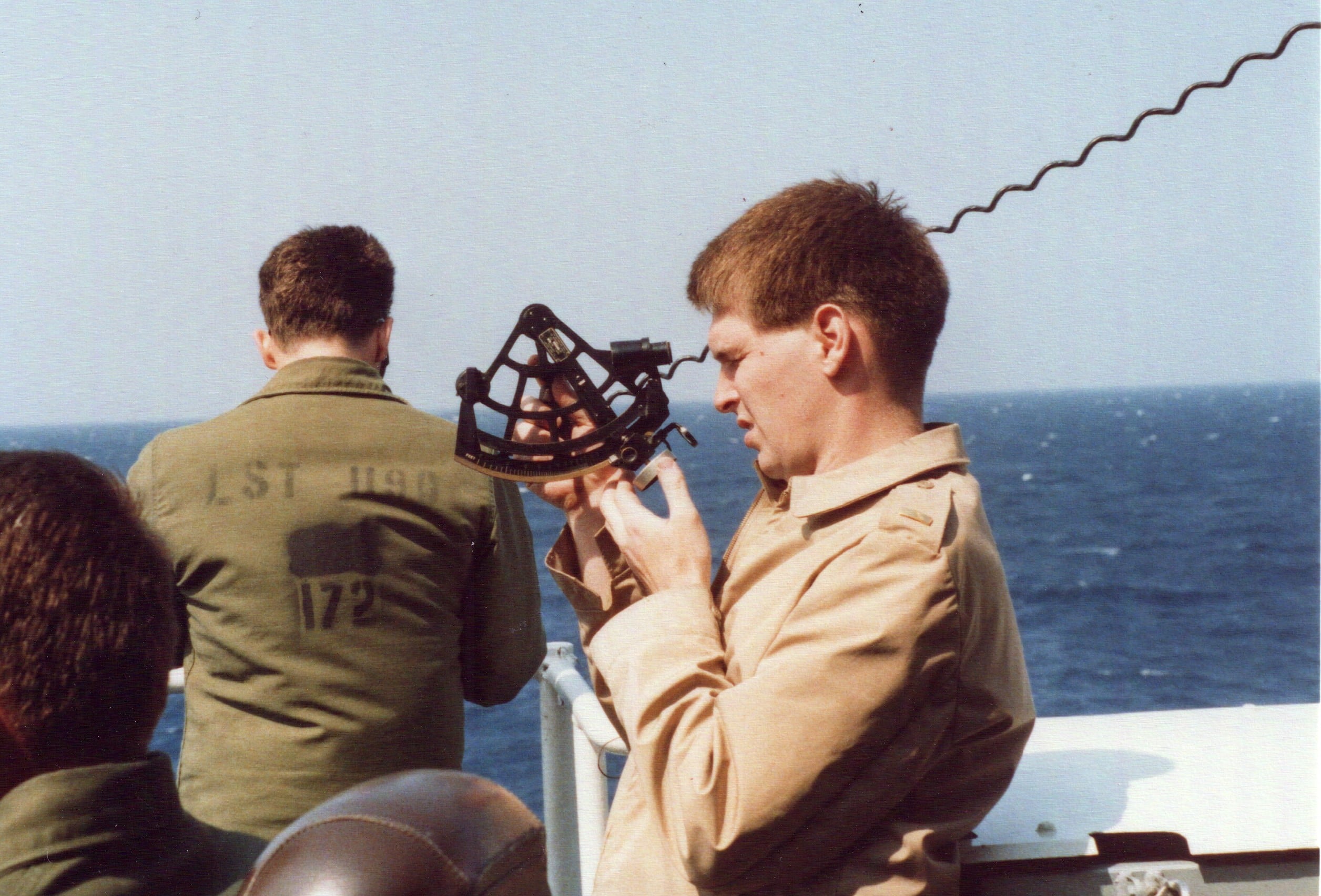
Being navigation officer was the job I loved more than any other in the Navy. The precision, the detail, the teamwork, everything about it. And I was doing that trusted role under the hawk eyes of a man who didn’t trust me.
Alder had rekindled in me, and I believe in the whole crew, a higher sense of purpose and esprit de corps. That was something Voss couldn’t take away, no matter how he commanded.
My next three weeks were filled with preparing the navigation charts for the crossing back to Little Creek. It rained every day, and the weather kept getting worse. The plan was to head south, through the English Channel, then west across the Atlantic, after first collecting our munitions from Trondheimsfjord.
We were in the shipyard for exactly thirty days, getting underway on October 21st.
By then we were facing a North Atlantic storm so severe that the decision was made to go the northern route, over the top of the UK, instead of shooting the Channel. It meant redoing all of the navigation charts, a lot of work, but it kept us out of some of the most dangerous waters. The Channel acts like a funnel. Shallow water and hard tidal currents turn a long Atlantic swell into short, breaking seas stacked one on top of the next, with no room to recover between them.
We sailed west from Trondheim, over Scotland, somewhere between the Shetland and Faroe Islands. I honestly don’t remember the exact route after all these years. What I do remember is that from there, it was basically a great circle route the rest of the way to Little Creek, Virginia.
We rode the back of that storm, with 30 to 45 foot seas for most of the crossing. Every four hours, I’d take a fix, and every time, we were an hour ahead of track. Six hours ahead the first day. Twelve hours ahead after two days. It kept compounding. We arrived home a day early.
The next two months were holiday stand-down, then back into amphibious operations training. Three weeks of Navigation Officer training in March ’89. Then we got word: we’d been selected for the Great Lakes cruise. A goodwill tour, all five Great Lakes, twenty port visits over three months, May through August. Some of the toughest navigation in the world. Prepping the 250 nav charts for a 7,000 nautical mile three-month Great Lakes cruise was massively more difficult than the trip home from Norway or the many amphib ops close to home.
My team trained for months so that everyone could do everyone else’s job. We were a small team. We couldn’t afford to lose someone to being sick and have a gap. And honestly, I just thought it was the right thing to do. The Executive Officer (XO) was fully behind it.
I’ll never forget it. We were navigating the St Lawrence River in the Thousand Islands region of New York, and my nineteen-year-old team member was doing my job, with the captain and the XO standing right there, and I was outside shooting fixes. That young man went from a boy to a man in those few minutes, the moment he realized he was doing an officer’s job, and that I and the XO trusted him that much. That was an incredible lesson for me, in holding a leadership standard regardless of what was happening above me. I had to trust my men. That never wavered.
At the same time, the captain kept watching me like a hawk, double-checking everything I did. He never showed me anything close to the trust Alder had given me in two months. And that was the whole time Voss was aboard, from the 28th of September until the day I left, the 11th of June, 1990. I don’t think he ever trusted me the way Alder had, even though by then I was operating at a level far beyond anything Alder had ever gotten the chance to see.
Through those three months, my team was operating at a level the Navy standard didn’t require. The standard for close-in navigation reporting is once a minute: ahead of track, behind track, left or right of track, time and distance to the next turn. We were doing it every thirty seconds. In the tightest channels in the Great Lakes, under real pressure, sustained for three months. That wasn’t luck. That was a team I’d built and trusted enough to let run at that level.
At one of the smaller ports on the tour, a place that doesn’t normally see a Navy ship, Ludington, Michigan, we were getting underway when something went wrong. There was some kind of miscommunication. Boulder surged forward unexpectedly and pulled the tug that was behind us. A man on the tug’s stern went overboard. He was later found dead.
I was on the bridge. Voss was there. When word came that a man was overboard, his first reaction wasn’t about the man in the water. My perception, then, as a twenty-four-year-old junior officer, and my perception now, is that his first concern was for himself, his own exposure, his own career. That was a complete reversal of what I would ever expect from a commanding officer. And it confirmed something I’d already started to see in him: that his focus wasn’t on the welfare of his crew or his ship. It was fear, focused inward, on himself.
I was never privy to the official investigation into what happened. What I do know is this. Alder was relieved of command over an incident where nobody died. Voss, to my knowledge, faced no significant consequence, over an incident where a man lost his life. I have never understood that, and I still don’t.
In early 1990, I was selected for CV RIP, the Carrier Readiness Improvement Program, one of only forty-five junior officers selected Navy-wide specifically to join a carrier to train fellow surface warfare junior officers. Voss had to provide a recommendation and sign off on it. Given everything else in our relationship, that felt strange. And yet here he was, putting his name on a recommendation for a silver bullet tour, a career fast track path, for me.
The night before I left, I stood the last watch of my time on Boulder. Officer of the Deck, Underway, at anchor, riding out a storm. In the Navy, “underway” doesn’t mean the ship is moving. It means you’re not moored to a pier. We were anchored, not docked, so the watch was still designated underway. It was the only OOD-underway watch I ever stood on that ship, in almost two years aboard.
I’ve wondered since why Voss gave me that watch, that night, of all nights. I was on watch in CIC, briefly, the night we ran aground in Norway. I was only there for a short time before the grounding happened, but I’ve always suspected that’s part of why he’d never given me an underway watch before. If that’s true, and I can’t say for certain that it is, then the very last thing he did before I left his ship was finally hand me something he’d withheld from me for almost twenty months.
The next day, under stormy skies, I left Boulder for good.
Voss came aboard in a shipyard in Norway, under gray skies and rain that didn’t let up. I left Boulder in a shipyard too, a dry dock in Virginia, under conditions just as bad. He came aboard that way. I left that way. It took me years to notice that the two moments bookended each other like that.
A lot of this didn’t really hit me until much later. For a long time, I resented being assigned to Boulder in the first place, a Naval officer assigned to a reserve force ship, not where I’d expected to end up. But when I actually left that ship, I didn’t just leave a job. I left a crew. I left my team, my division, X Division, and that wasn’t just the quartermasters. It was the yeoman, the corpsman, everyone who made up that division. We had built something tight. A real level of respect and trust for each other.
Leaving was bittersweet. I was relieved to be out from under Voss’s watch, out from under the constant lack of trust. But the ship had grown on me in ways I never would have expected, and never would have admitted to myself at the time.
Same ship. Same crew. Three completely different outcomes.
Thirty-six years later, I can see how much those two-plus years shaped me. The only thing that ever changed was the person in command.
Sources
[1] Lieutenant Commander Edwards, U.S. Navy. “Image of Command.” U.S. Naval Institute Proceedings, February 1970, Vol. 96/2/804.
[2] Lieutenant Barry Gittleman, U.S. Navy. Letter, “Comment and Discussion.” U.S. Naval Institute Proceedings, November 1996, Vol. 122/11/1,125.